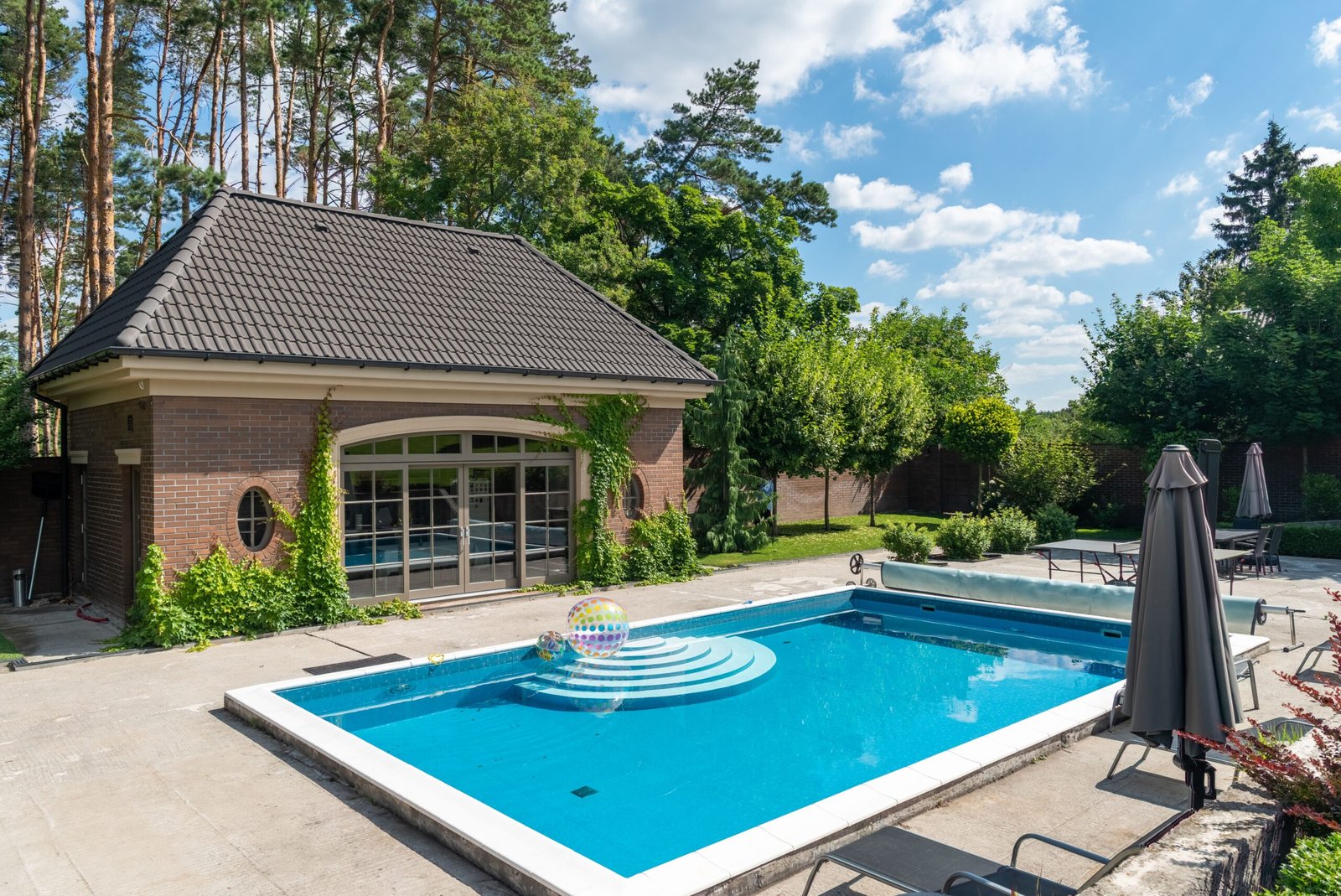
A swimming pool built without a licence in the Balearic Islands can lead to a fine of between 50% and 300% of the value of the works, depending on the type of land. This is set out in Article 167 of the Balearic Planning Act, Law 12/2017 (LUIB). The fine is only part of the problem. The authorities can also require you to legalise the pool or demolish it.
Many of these pools were built years ago, others came with the purchase of the house and some were built with the idea of legalising them later. In all three cases, your legal position depends on two facts: the type of land and the date the works were completed.
At Rodríguez Tur Abogados we handle planning enforcement and legalisation cases in Ibiza and the rest of the Balearic Islands. This guide reflects the law in force in November 2026, including the changes introduced by Law 7/2024.
The key points in 30 seconds
- A pool that involves building work (excavation or concrete) needs a municipal licence throughout the Balearic Islands.
- Fines under Article 167 LUIB: 50% to 100% of the value of the works on urban land, 100% to 250% on common rural land and 250% to 300% on protected rural land.
- The authorities have 8 years from completion of the works to open proceedings to restore planning legality. On protected rural land there is no time limit.
- If you apply for legalisation within the period the town hall gives you, the fine is reduced by 50%.
- On rural land, pools where the infringement is time-barred can be regularised through the extraordinary legalisation procedure. In Ibiza the deadline is 3 April 2028.
Do I need a licence to build a swimming pool in the Balearic Islands?
Yes. Any pool that involves building work needs a municipal planning licence: excavation, concrete, a fixed shell or buried installations. It makes no difference that the plot is yours or that the pool is for private use. The licence is granted by the town hall of the municipality where the property is located.
Removable or above-ground pools that sit on the ground without any building work are usually outside the scope of a works licence. Even so, each town hall regulates volumes, installations and pools on terraces in its own way. Check your municipal by-laws before installing one, especially on a roof or a penthouse terrace.
Limits for new pools on rural land
Since Decree-Law 9/2020, now incorporated into Article 68 bis LUIB, a single-family home on rural land can only have one pool per property, with a maximum water surface of 35 m² and a maximum volume of 60 m³. The Ibiza Island Territorial Plan and each municipality’s planning rules can add further conditions. Santa Eulària des Riu, for example, has a specific amendment to its planning regulations on pools.
How to check whether a pool has a licence
The document that proves it is the works licence authorising the pool, or the licence for the house if the pool is included in its project. You can request it from the town hall’s planning archive. If the seller cannot provide it, treat it as a warning sign.
A land registry extract (nota simple) is not enough. A pool can be recorded at the Land Registry without a licence, because the Registry reflects the civil-law status of the property. The Cadastre does not prove the licence either: it only shows that the pool has been entered in its database.
What happens if you build a pool without a licence: the two sets of proceedings
When the authorities detect an unlicensed pool, they can open two different sets of proceedings. They run separately and closing one does not close the other.
Sanction proceedings
Their purpose is to impose a fine. The person who promoted or carried out the works is liable. A later buyer who had no part in the construction is not usually the one fined, although they may receive the second set of proceedings.
Proceedings to restore planning legality
These proceedings seek to have the pool legalised or, if that is not possible, demolished. They are brought against whoever owns the property when they are opened, regardless of who built the pool. If you buy a house with an illegal pool, the order is addressed to you.
There are two possible outcomes. If the pool complies with current planning rules, the town hall gives you a period to apply for a legalisation licence. If it does not, it orders the pool to be demolished and the land restored at your expense. If you fail to comply, Article 194 LUIB allows up to twelve coercive fines, imposed at least one month apart.
How much can the fine for an illegal pool in the Balearic Islands be?
The fine is calculated as a percentage of the value of the works. That value is set by the authorities using technical criteria and may not match what you paid the builder. The percentage depends on the land where the pool is located:
| Type of land | Fine (Article 167 LUIB) |
|---|---|
| Urban or developable land | 50% to 100% of the value of the works |
| Parks, gardens, open spaces, public facilities and other land reserved for facilities | 150% to 300% |
| Common (unprotected) rural land | 100% to 250% |
| Protected rural land | 250% to 300% |
For a pool valued at €20,000, the fine would range from €10,000 to €20,000 on urban land, from €20,000 to €50,000 on common rural land and from €50,000 to €60,000 on protected rural land. A recent Ibiza case shows the scale: in 2026 the Consell d’Eivissa upheld a fine of 250% of the value of the works, over €1.47 million, for five buildings with a pool on protected ANEI rural land in Sant Joan de Labritja.
How to reduce the fine
Article 176 LUIB rewards those who regularise early:
- If the pool can be legalised and you apply for the licence within the period the authorities give you, the fine is reduced by 50%.
- If you apply after that period, but before the decision ordering the restoration of legality, it is reduced by 40%.
- If you demolish voluntarily before that decision, it is reduced by 60%. If you do so afterwards, within the period granted, by 50%.
These reductions are lost if you failed to comply with an order to suspend the works. In any case, the minimum fine is €600 per liable person.
Paying the fine does not legalise the pool
This is the most common mistake. Paying the fine closes the sanction proceedings, but the pool still has no licence. The town hall can continue to require legalisation or demolition. Only a legalisation licence regularises the property.
The fine becomes time-barred before the works do
Under Article 205 LUIB, fines become time-barred four years after the decision imposing them becomes final. Serious and very serious infringements become time-barred after eight years and minor ones after one year. The limitation of a fine that has already been imposed does not affect the period for requiring legalisation or demolition, which runs separately.
When does an unlicensed pool become time-barred in the Balearic Islands?
Article 196 LUIB gives the authorities eight years from full completion of the works to open proceedings to restore planning legality. In addition, the decision opening the proceedings must be served, or service must be attempted, before that period ends. Once eight years have passed without proceedings, the authorities can no longer order the demolition of that pool.
The period runs from the date the pool was completed, not from when the works started or when the authorities found out about it. The burden of proving that date is on you, and since Law 7/2024 any means of evidence admissible in law can be used. We have a more detailed guide on when unlicensed construction becomes time-barred in the Balearic Islands.
When there is no time limit
There is no time limit on proceedings to restore planning legality in these cases (Article 196.2 LUIB):
- Pools on protected rural land, such as ANEI areas and other areas of special protection.
- Pools affecting listed assets or assets of cultural interest, parks, gardens, open spaces, public infrastructure or other land reserved for public facilities.
A pool on this land can receive a demolition order even if it is twenty years old. If it also encroaches on the maritime-terrestrial public domain or its easement zone, the Coastal Act applies as well, with its own rules.
The 2024 change for common rural land
Until December 2024, the LUIB provided that any unlawful works on rural land were never time-barred. Law 7/2024 restricted that rule to protected rural land, so the eight-year period applies again on common rural land. Works completed before 2018 are governed by the previous law (Law 2/2014, LOUS), also with an eight-year period. If your pool on common rural land was completed between 2018 and 2024, the limitation period needs to be reviewed case by case.
What evidence proves the age of a pool
- Historical aerial photographs from the Balearic Government’s IDEIB viewer, with flights from 1956, 1984 and 1989 and regular flights since 2002, and those of the National Geographic Institute’s PNOA programme. If the pool appears in a dated image taken more than eight years ago, it is strong evidence.
- Builder’s invoices showing the date and a description of the works.
- Maintenance, chemical, water or repair bills showing continuous use.
- Historical cadastral certificates, as supporting evidence.
- An architect’s report dating the works from their materials and installations.
How the authorities detect unlicensed pools
The chances of detection are high. A pool is visible from the air and has an unmistakable shape. These are the most common routes.
Aerial flights and orthophotos
The authorities compare orthophotos from different years to identify new constructions. In Mallorca this is done by the Consell de Mallorca’s Agència de Defensa del Territori (ADT): in 2020 alone it detected 39 unlicensed pools, around 30% of the new infringements that year. In Menorca, the Consortium for the Protection of Planning Legality on Rural Land carries out this role.
The Consell d’Eivissa and the town halls
In Ibiza, planning enforcement is the responsibility of the town halls, and the Consell d’Eivissa intervenes on rural land. It can require the town hall to open proceedings, halt works and impose fines, as in the Sant Joan case mentioned above.
Complaints from neighbours
A complaint obliges the authorities to check whether the pool has a licence. This is common in residential developments and in disputes between neighbours over other issues.
New licences and Land Registry entries
If you apply for a licence for a renovation or an extension, the town hall’s technical staff review the status of the whole plot. A pool that does not appear on the approved plans can lead to proceedings. The same applies if you register the pool at the Land Registry on the basis of its age: the registrar notifies the town hall.
Waiting for the infringement to become time-barred only makes sense if the period has already passed or is about to, and if the land allows time-barring. In all other cases, regularising before you receive a notice can save you up to half of the fine.
How to legalise a swimming pool in the Balearic Islands: steps and requirements
Ordinary legalisation is handled by the town hall. On urban land it is usually feasible if the pool complies with current planning rules.
Step 1: check whether it can be legalised
The pool must comply with the planning rules in force today, not those in force when it was built. The architect reviews the land classification, the setbacks from boundaries and roads set by your municipality, the plot coverage and whether the pool counts towards the buildable area. On rural land, also the 35 m² and 60 m³ limits in Article 68 bis.
Step 2: commission the legalisation project
It is drawn up and signed by an architect or building engineer. It describes the pool as built and shows that it complies with the rules, or what changes are needed to comply. An architect who knows the municipality reduces the number of requests for corrections.
Step 3: submit the application
It is filed at the town hall’s registry with the project, the licence application form, the title deed and proof of payment of the fees. Processing times vary widely between municipalities.
Step 4: pay fees and taxes
You will pay the licence fee and the Construction, Installations and Works Tax (ICIO), in accordance with your municipality’s tax by-laws.
Step 5: declare the new construction
Once the licence is granted, you can declare the pool before a notary and record it at the Land Registry and the Cadastre. This is not required for the licence to be valid, but it leaves the property fully regularised in all registers and makes a sale or a mortgage easier.
What costs a legalisation involves
| Item | How it is calculated |
|---|---|
| Legalisation project | Architect's or building engineer's fees, as quoted |
| Planning licence fee | Municipal tax by-law, based on the cost of the works |
| ICIO (construction tax) | Percentage set by each town hall on the cost of the works |
| Notary and Land Registry (new build declaration) | Notary and registry fees, based on the declared value |
| Fine, if proceedings are open | Percentage under Article 167, with the reductions in Article 176 |
Even with everything added up, legalising in time is almost always cheaper than an unreduced fine plus a possible demolition.
Pools on rural land: the most complex case
In Ibiza and Mallorca there are thousands of homes on rural land with pools built decades ago without a licence. On this land, only what the rules expressly allow is permitted. That is why ordinary legalisation faces more obstacles.
Common rural land versus protected rural land
On common rural land, the pool may be legalised if the house has a licence, if it is the only pool on the property and if it meets the 35 m² and 60 m³ limits and the conditions of the Island Territorial Plan and municipal planning. Many older pools exceed these limits and cannot be legalised through the ordinary route.
On protected rural land, ordinary legalisation is almost always unfeasible and proceedings to restore legality are not time-barred. The only route is usually extraordinary legalisation, if its requirements are met.
An irrigation pond is not a way out
Some owners try to present the pool as an agricultural irrigation pond. This requires genuine agricultural activity and an installation consistent with that use. A pool with steps, a chlorine filtration system and mosaic tiles will not pass as a pond, and the attempt can make the proceedings worse.
The planning amnesty: legalising pools where the infringement is time-barred
The seventh additional provision of Law 7/2024, which originates from Decree-Law 3/2024, introduces an extraordinary legalisation procedure for buildings, constructions, installations and uses on rural land. It allows legalisation without applying the general planning parameters for rural land, such as the 35 m² water surface limit. You can find more details in our article on the planning amnesty in the Balearic Islands.
Deadline and financial contribution in Ibiza
Each Island Council has to activate the procedure on its island, and the three-year period runs from the publication of its agreement. In Ibiza, the Consell d’Eivissa agreement was published in BOIB no. 41 of 3 April 2025, so the deadline is 3 April 2028. The Consell de Mallorca and the Consell de Formentera have approved their own agreements.
In addition to the fees and taxes for a new build, a contribution is paid to the town hall based on the material execution cost:
| When the application is filed in Ibiza | Contribution on the material execution cost |
|---|---|
| First year (April 2025 to April 2026) | 10% |
| Second year (April 2026 to April 2027) | 12.5% |
| Third year (April 2027 to 3 April 2028) | 15% |
For a pool with an execution cost of €20,000, the contribution would currently be €2,500 in Ibiza. If your average personal income tax base over the last four years is low, the contribution is reduced by 50% or 25%, depending on income band.
Requirements for a pool
- It must be on rural land.
- The time limit for proceedings to restore legality must have expired when the application is submitted.
- On protected land, the works must have been completed before the rules prohibited that use.
- The application must include all works and uses on the same property. That is why the pool is usually legalised together with the house.
- It must not affect the public domain, road, coastal or water protection zones, or be located in a flood zone.
The project must include water treatment measures and the landscape integration and efficiency measures set by each town hall. A home legalised through this route can no longer be marketed as a holiday let, and this restriction is recorded at the Land Registry. If the town hall does not decide within six months, the application is deemed approved.
The procedure is already being used in Ibiza. Santa Eulària des Riu had received 185 applications by June 2026, with 27 approvals, and in November a project for a property in Santa Gertrudis including two pools was published in the BOIB. Bear in mind that this provision has been challenged before the Constitutional Court (appeal no. 1840-2025) and a ruling is pending.
Frequently asked questions about unlicensed pools in the Balearic Islands
Generally yes, if it sits on the ground without excavation, foundations or fixed installations. Some town halls regulate volumes or pools on terraces and roofs, so check your municipal by-laws. If any permanent work is needed, you need a licence.
You can sell it, but the buyer must be aware of the situation. If you conceal it and proceedings are later opened, the buyer can bring a claim against you. The best approach is to regularise before selling or to set out the situation and how costs are shared in writing in the contract.
Not always. Time-barring prevents you from being forced to demolish it, but ordinary legalisation requires compliance with today’s planning rules. If it does not comply, it remains non-conforming (fuera de ordenación). On rural land, the extraordinary legalisation under Law 7/2024 may be the way to regularise it.
On protected rural land or in listed or public facility areas, yes, because there is no time limit. On urban land or common rural land, if more than eight years have passed since completion without proceedings being served, demolition can no longer be required.
Yes, if the pool complies with planning rules. If you apply for the licence within the period you are given, the fine is reduced by 50%. Act as soon as you receive the notice, because an application submitted after the decision to restore legality no longer qualifies for a reduction.
It depends on the municipality and the type of land. In extraordinary legalisation, the town hall has six months to decide and, if it does not, the application is deemed approved. In the ordinary route, timings depend on each town hall, so it is worth following up on the file from the first month.
It depends on your municipality’s planning rules. In some, sunken pools do not count and in others they do, fully or partly. If the plot has used up its buildable area, this can block ordinary legalisation, so the architect should check it before starting.
How Rodríguez Tur Abogados can help you
Every unlicensed pool has a different answer. It depends on the land, the completion date, whether proceedings are already open and whether it qualifies for extraordinary legalisation. Juan Carlos Rodríguez Tur, the firm’s managing partner, advises owners in Ibiza and the rest of the Balearic Islands on planning infringements, from pools and porches to entire homes on rural land.
If the infringement is not time-barred
We assess whether the pool can be legalised through the ordinary route and coordinate the project with the architect. If proceedings are already open, we prepare the submissions and seek to apply the reductions in Article 176.
If the infringement is time-barred
We check that the time-barring can be proven, review whether your property qualifies for extraordinary legalisation and calculate the contribution before you decide.
If you are buying a house with a pool
We carry out planning due diligence before you sign: licence, open proceedings, time-barring and legalisation options. With that report you can negotiate the price and agree protective clauses.
Call us on +34 871 735 091 or contact us through the contact form. We will give you an initial assessment of your case. We work in Spanish, Catalan, English and Italian.